





Cybersecurity for Law Firms in 2026: Why Response and Client Trust Are Inextricably Linked
Posted : 18 March 2026
Posted In : Blogs

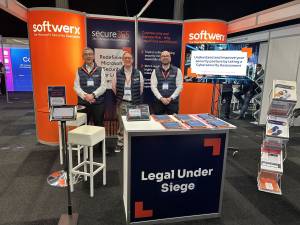
At LegalEx in Manchester and London last month, and the British Legal Technology Forum last week, one theme cut through every conversation. Most mid-sized UK law firms believe they are reasonably cybersecure. They use Microsoft 365®. They have security policies. They are renewing their cyber insurance. Yet when we ask one simple question, conversations become more thoughtful: If we were breached tomorrow, how quickly could we contain it, and how would our clients judge our response?
That is the real test of cybersecurity for law firms in 2026.
Prevention can no longer be the headline
Cyber breaches are not rare events. 43% of UK businesses reported a breach or attack in 2024/25 (DSIT Cyber Security Breaches Survey 2025). In legal, the impact of a breach is amplified by the sensitivity of the data involved and the regulatory context in which firms operate. Phishing and business email compromise remain common entry points. Ransomware continues to disrupt organisations of all sizes. For UK law firms however, even a contained incident can quickly become a client trust issue.
For years, cybersecurity for law firms centred on breach prevention. In 2026, the inevitability of cyberbreaches mean that stakeholders are increasingly judging maturity differently:
- How quickly did you detect the issue?
- How effectively did you contain it?
- How clearly did you communicate?
- Could you evidence your controls?
In the legal world, trust now requires proof.
The illusion of security
Even though the typical UK law firm tends to be of midmarket scale, the nature of their businesses dictate that enterprise-grade technology and cybersecurity is required. The Microsoft Security stack embedded within Microsoft 365 includes advanced threat protection, identity controls and data protection capabilities. That foundation is strong. But resilience does not come merely from ownership. It comes from how that technology foundation is operated daily. Effective operational readiness means you can detect, contain and communicate cyber threats decisively – even outside business hours.
It requires: consistently enforced identity controls; clear visibility of where sensitive client data sits; continuous 24x7x365 monitoring, not just office-hours oversight; and a rehearsed and confident incident response capability.
These are leadership questions as much as technical ones. Technology alone does not create confidence. Evidence does.
AI has raised the stakes again
Legal practices are not just experimenting with AI. Automated contract parsing, drafting support and knowledge retrieval are already embedded in daily workflows. AI brings efficiency. It also introduces potential accountability issues. Clients are asking how their data is being used. Consumer AI tools are already inside your firm, whether your policies account for them or not. Meanwhile, AI is changing how cyber threats are executed and scaled.
The question is no longer simply “Are we secure?” It is “Can we demonstrate control?”
Responsible AI adoption rests on disciplined identity management, data governance and continuous oversight. Without that, apparent technical innovations such as AI can actually quietly erode trust.
The 4am test
There is one scenario every managing partner should consider. If something happens at 4am, who knows about it before your clients do? Large enterprises build internal Security Operations Centres to deliver 24x7x365 monitoring. Most mid-sized law firms just don’t have the scale to be able to justify that investment. Yet phishing, ransomware and account compromise do not respect business hours for any size of business. The difference between a contained incident and a reputational crisis often comes down to detection speed.
Managed eXtended Detection and Response services such as secure365® provide that operational depth. Built on Microsoft Security technologies and delivered round the clock by UK-based Softwerx analysts, this approach closes the gap between technology ownership and real-world response. Effectively, Softwerx transparently takes over the operation of your security operations, so that you don’t have to.
For managing partners, the value is not technical detail. It is reassurance that an overnight issue does not quietly escalate into a morning crisis.
Trust is the commercial asset
For UK law firms, cybersecurity is a client-facing issue. It is part of how you win, retain and reassure clients. Insurers expect demonstrable controls, regulators expect preparedness and clients expect maturity. The firms that thrive will not be those claiming perfection. They will be the firms that demonstrate composure, containment and clarity when something goes wrong.
Because it is rarely the breach itself that erodes confidence. It is the perception that you were unprepared. And in the modern legal market, trust is not a soft value. It is a hard, commercial one.
Related insights


Getting started with us couldn’t be easier.
Just use the form or call us on +44 (0) 1223 834 333 to set up a call.