





The people cybersecurity needs next
Posted : 4 November 2026
Posted In : Blogs

Written by:
Alex Fodor, Head of Security Operations
The people cybersecurity needs next
Technical skill starts an investigation; judgement, clear explanation and a feel for business impact decide how the incident ends, and they can often be learned in other careers first.
Leading security operations at Softwerx has confirmed something I have suspected for most of my career. Technical skill is the foundation of this work and I would never play that down. The people who make the biggest difference to a customer, though, tend to be the ones who can also weigh risk, keep their explanations clear under pressure and tie a security decision back to what it means for the business.
Our teams spend their days investigating suspicious activity, responding to incidents and helping customers work out what deserves their attention first. Very few alerts stay technical for long. An odd sign-in in the middle of the night can turn, quite quickly, into a conversation about whether to take a system offline, and that is a business decision. The analysts who handle those moments well are comfortable working from incomplete information and can explain what they have found in terms a managing director can act on.
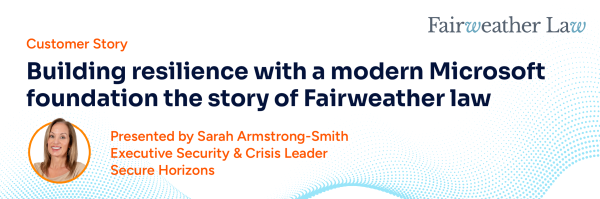
We see the same pattern across the mid-market organisations we support, where IT teams are lean and a security decision seldom stays inside one function for long. We took that thinking into a recent fireside chat on ‘the unconventional candidate’ and the different routes into security, with Sarah Armstrong-Smith, Strategic Advisor to the Softwerx Executive Committee. Her own route ran through fraud, business continuity and crisis leadership before she became Chief Security Advisor at Microsoft EMEA, and it backs up something we see in our own teams: much of the judgement this work depends on is learned in other jobs first.
The job is broader than the role
Asked which hiring assumption the industry should retire, Sarah didn’t hesitate: “You have to be a techie to work in cybersecurity.” Plenty of our roles are highly technical, and deep knowledge of Microsoft Security® technologies sits at the centre of our work as a Microsoft-first security specialist. Even so, protecting a customer day to day rarely fits neatly into technical or non-technical boxes.
The latest skills data backs both halves of that. DSIT’s labour market report, published on 29 September, found that 57% of UK businesses have a basic technical skills gap, up from 49% a year earlier, so nobody should read this as a case for caring less about technical depth. It also found that candidates who combine technical and complementary skills remain highly sought after; one large cyber security business told the researchers that finding someone technically skilled who can also manage people is “virtually impossible.”
The strongest analysts, consultants and security leaders I’ve worked with share one instinct. They keep looking when the first answer feels too easy, and they will make a call before every fact is in, then explain it clearly to whoever needs to act on it. Technical skill tells them what they are looking at; deciding what to do about it is a separate ability, and it’s the one I look for.
Experience gained elsewhere still counts
Sarah’s own route through fraud and business continuity shaped how she reads risk. “The method changes,” she told us, “the motivation doesn’t.” Detection technology keeps getting better at catching known techniques, so attackers lean harder on trust and human behaviour: phishing, credential theft, extortion and business email compromise all depend on it.
Attackers go where the return justifies the effort, and DSIT’s latest breaches survey shows medium-sized businesses feeling it: 65% of those with 50 to 249 staff had experienced a breach or attack in the previous 12 months, against 43% of businesses overall. They hold valuable data, often sit in the middle of lucrative supply chains and have fewer specialists than a large enterprise, so the disruption can reach well beyond the business first hit. Seeing that wider picture, which Sarah calls a “big picture view of the world”, is what lets our people explain why a technical weakness matters to a particular business and where attention should go first.
Relevant experience is often hidden inside ordinary job titles. A good service desk colleague has usually spent years extracting the real problem from an incomplete description without making the person asking for help feel foolish. Audit builds patience with evidence and the confidence to question anything that doesn’t add up, and business continuity teaches people to look past the first technical failure to the services the organisation needs first. Anyone entering security still has the technology to learn, but habits like these give them a real head start.
Our most effective people can work both sides of an incident: the technical investigation and the business decision that follows it. A compromised identity, a ransomware attack or a supply chain problem can travel from an analyst’s queue to an executive call within the hour, and by then the conversation is about operational continuity, customer impact, regulatory obligations and commercial risk. People who came into security from fraud, audit or operations have often made that kind of translation before, which is part of why those routes matter to us.
Plans matter, but so does the person using them
Preparation matters, because an organisation cannot afford to make every decision for the first time during a live attack. The same DSIT survey found that 57% of medium-sized businesses have a formal incident response plan, which puts them ahead of the rest, but rehearsal can still create a false confidence. Sarah described executive exercises with a ransomware scenario, tea and coffee, backups that restore on cue and the business running again by morning, after which everyone goes back to work. Real incidents rarely behave so politely, and a plan that looked complete in the exercise can be out of date within the first hour.
Sarah put it bluntly: “Do you really, really want to be in the middle of an active cyberattack and then going, ‘Now what?'” She described attackers joining a company’s own crisis calls, listening as the executives agreed they would never pay, then mentioning that the backups the team was counting on were the ones being deleted as they spoke. A plan only helps if the people using it can tell a real priority from deliberate noise and recognise when events have moved beyond the assumptions it was built on. That judgement may have developed inside security or in any other setting where decisions carry consequences and complete information is rare.
Different backgrounds change what a team notices
The industry often talks about diversity in terms of workforce percentages. Those figures matter, but they tell us little about what different experience does for a team. The question we ask is more practical: does a broader mix of backgrounds help us spot risks, challenge assumptions and understand what we’re protecting? I think it does, because someone who has seen a problem from another angle is more likely to find the blind spot. Threat actors don’t share a single motive or worldview either, and Sarah’s view is that security teams need “people from multiple ages, different backgrounds, different cultures, because that’s where the threat actors come from.”
Growth can make hiring too cautious
Rapid growth can make hiring more conservative. When teams are busy, familiar CVs feel safer and job descriptions start asking for the same products, certifications and job titles already represented in the room. That fills a vacancy quickly but tends to leave a team thinking the way it already did. Certifications and product experience still matter, and the standard for each role should stay high; a CV just shows what someone has used and held, and far less of how they think when the evidence is incomplete, which is what counts once they’re in the room.
Sarah brought her final answer back to the relationship between business and technology: “The two must come together.” Strong technical analysis still must end in a decision that makes sense for the customer, given how the business operates and what else it’s carrying. A team where everyone thinks alike is quicker to hire and tends to be weaker in an incident; I would rather build one whose members see different things, question each other and stay focused on keeping our customers operating securely.
To hear Armstrong-Smith’s full perspective on ‘the unconventional candidate’, watch the fireside chat below.
Related insights


Getting started with us couldn’t be easier.
Just use the form or call us on +44 (0) 1223 834 333 to set up a call.